CFA® Level 1 Prep Course
CFA® Level 1 Prep That Fits Your Goals and Budget
From an all-inclusive CFA Level 1 course to focused CFA Level 1 prep materials, our customizable packages give you exactly what you need to prepare effectively - without paying for what you don’t.
CFA® Level 1 Prep That Fits Your Goals and Budget
From an all-inclusive CFA Level 1 course to focused CFA Level 1 prep materials, our customizable packages give you exactly what you need to prepare.
eBook Only
eBook Only
eBook + Printed Book Set
2 Mocks
5 Mocks
| Practice with questions written by finance experts to reflect the most current CFA Level 1 Exam in difficulty and format. | ||
|
||
| Monitor your progress, identify weak areas, and optimize your prep using detailed performance analytics. | ||
| Take your CFA prep on the go with full access to all study materials via the UWorld Finance - Exam Prep mobile app. | ||
| Save key content, take notes, and build a personalized digital study guide as you learn. |
| Practice with questions written by finance experts to reflect the most current CFA Level 1 Exam in difficulty and format. | ||
|
||
| Monitor your progress, identify weak areas, and optimize your prep using detailed performance analytics. | ||
| Take your CFA prep on the go with full access to all study materials via the UWorld Finance - Exam Prep mobile app. | ||
| Save key content, take notes, and build a personalized digital study guide as you learn. | ||
| Create a personalized study plan aligned to your test date and progress, helping you stay on track. | ||
| Get additional context and depth with bite-sized review videos that hone in on learning outcome statements. | ||
| Reference an outline of key formulas, definitions, and must-know concepts in a streamlined format for quick review. | ||
| Create your own flashcards to reinforce key concepts, formulas, and definitions. Organize them by subject, topic, or custom tags. Study your personalized deck anytime, anywhere across devices. | ||
| Study with preloaded, expert-curated flashcards organized by subject, topic, or custom tag. | ||
|
| Practice with questions written by finance experts to reflect the most current CFA Level 1 Exam in difficulty and format. | ||
|
||
| Monitor your progress, identify weak areas, and optimize your prep using detailed performance analytics. | ||
| Take your CFA prep on the go with full access to all study materials via the UWorld Finance - Exam Prep mobile app. | ||
| Save key content, take notes, and build a personalized digital study guide as you learn. | ||
| Create a personalized study plan aligned to your test date and progress, helping you stay on track. | ||
| Get additional context and depth with bite-sized review videos that hone in on learning outcome statements. | ||
| Reference an outline of key formulas, definitions, and must-know concepts in a streamlined format for quick review. | ||
| Create your own flashcards to reinforce key concepts, formulas, and definitions. Organize them by subject, topic, or custom tags. Study your personalized deck anytime, anywhere across devices. | ||
| Study with preloaded, expert-curated flashcards organized by subject, topic, or custom tag. | ||
|
||
| Request a free course extension if you don’t pass the CFA Exam on your first try, giving you more time to succeed. | ||
| The TotalPrep Series is a 3-phase learning program designed to help CFA candidates maximize their exam performance. It includes Expert MasterClass, Accelerate BootCamp, and Live Q&A, each focused on different parts of the prep journey — from core concept review to last-minute support. |
Our 4-Step Method to Pass CFA Level 1 First Time
UWorld’s all-in-one CFA Level 1 Exam Prep Course & Study Materials doesn’t just help you study - it trains you to think like a CFA charterholder. Our integrated system combines expert-led videos, concise study guides, exam-level practice, and realistic mock exams so you walk into test day fully prepared and confident.
Learn from Peter Olinto (CPA, JD, CFA) and elite instructors. Focused video lessons break down each LOS with clear explanations, real-world examples, and visuals that make complex concepts click.
Master More. Study Less. Skip the thousands of curriculum pages. Our Level 1 Study Guides deliver only what matters with clear, exam-ready notes aligned to every LOS. Get simplified explanations without jargon, practical real-world examples, and focused content that cuts study time without sacrificing results.
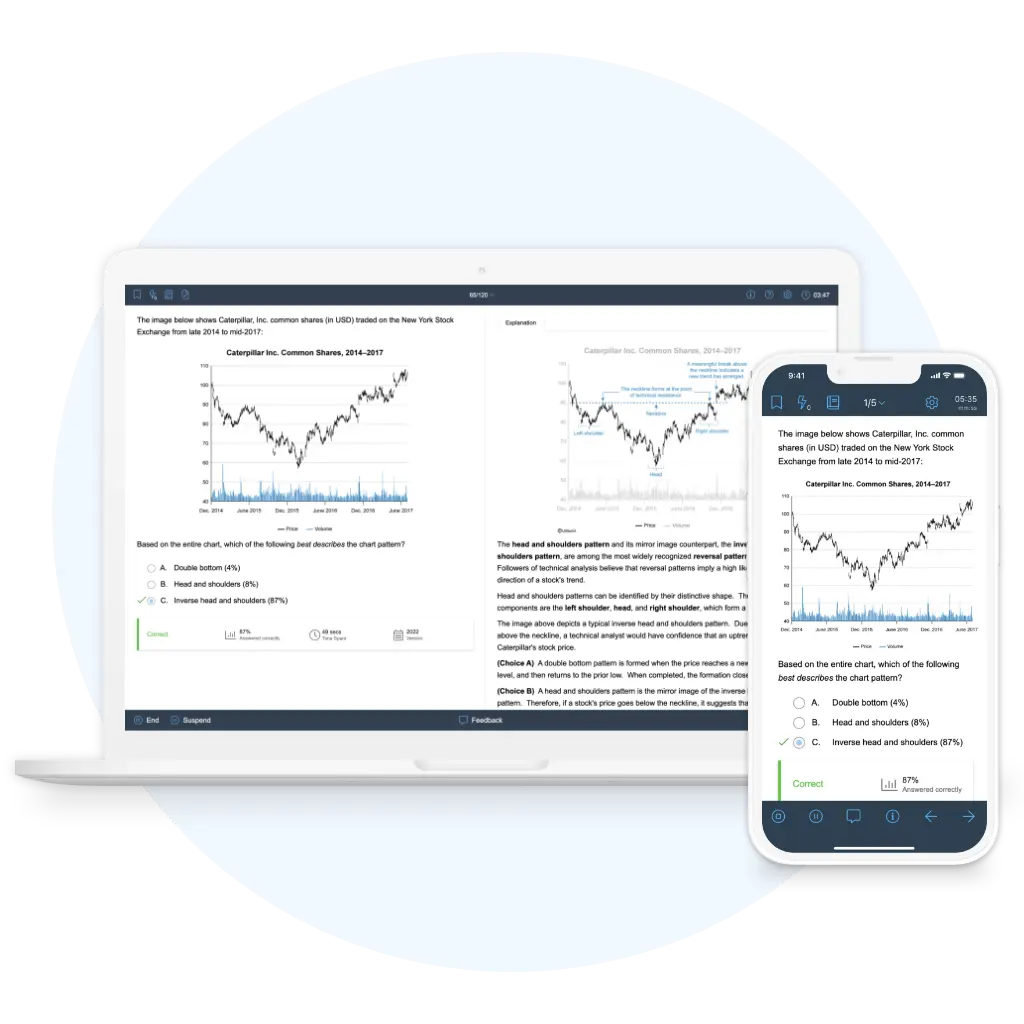
View Sample GuideLearn the Why. Master the How. Turn knowledge into exam-day performance with 2,000+ Level 1 questions written by CFA charterholders. Every question mirrors the real exam's format, difficulty, and logic - supported by industry-leading visuals that clarify complex concepts and in-depth rationales that explain every answer choice.
According to the Modigliani-Miller propositions (with taxes), if a company increases its debt level, its market value will most likely:
- decrease since the costs of financial distress are increasing.
- remain the same since the market value is unaffected by the capital structure.
- increase proportionally to the change in debt.
Explanation:
The Modigliani-Miller (MM) propositions assume perfect capital markets (ie, no arbitrage, no transaction or bankruptcy costs, and symmetric information) and assert that a company's market value equals the present value of its future cash flows. Modigliani and Miller propose that, in the absence of taxes:
- A company's capital structure does not affect its value (MM I without taxes); and
- A company's cost of equity (re) is directly proportional to its debt-to-equity ratio (D/E), but WACC remains constant (MM II without taxes).
However, these propositions change when there are corporate taxes:
- The market value of a levered company is greater than the value of an unlevered but otherwise identical company; tax-exempt interest payments improve the levered company's cash flows, increasing its value. The difference in value is the amount of the debt tax shield (tD), which is the product of a company's tax rate (t) and value of debt (D) (MM I with taxes).
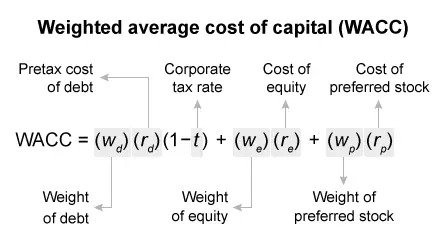
- A company's re is directly proportional to D/E, adjusted by (1 − t). Greater leverage will increase the cost of equity, but at a slower pace due to taxes. The greater the tax rate (t), the slower the increase in re when D/E increases (MM II with taxes).
Therefore, with taxes, an increase in debt will proportionally increase a company's value and reduce its WACC.
(Choice A) The MM propositions assume no cost of financial distress.
(Choice B) The market value would remain the same in the absence of taxes.
Things to remember:
The Modigliani-Miller (MM) propositions assume perfect capital markets (ie, no arbitrage, no transaction or bankruptcy costs, and symmetric information). When these propositions include corporate taxes, greater leverage will increase a company's market value (MM I) and reduce its WACC (MM II).
If a professional organization has standards of conduct in addition to its code of ethics, the purpose of the standards is most likely to describe:
- shared principles.
- laws and regulations.
- acceptable behaviors.
Explanation:
| Instruments for compliance with professional ethics | ||
|---|---|---|
| Instrument | Owner | Describes |
| Code of ethics | Professional organization | Shared principles |
| Standards of conduct | Professional organization | Minimally acceptable behavior |
| Laws and regulations | Government | Legal limits of behavior |
A code of ethics is a professional organization's statement of shared principles. Standards of conduct provide a guide to practicing the principles outlined in the code of ethics. Standards of conduct also clarify the minimally acceptable behaviors required to conform to the code of ethics. Although not addressed directly in standards of conduct, adherence to civil laws and regulations may be the minimally acceptable behavior in some cases.
Standards of conduct may be principle-based or rule-based. Principle-based standards are universally applicable to members of the profession and are based on the principles outlined in the code of ethics. Rule-based standards, while also relating to the principles in the code of ethics, are usually more narrowly applicable and specific to certain members or scenarios that may arise.
A code of ethics may or may not be accompanied by standards of conduct whereas standards of conduct exist only to enhance their associated code of ethics. CFA Institute has adopted both a code of ethics and standards of conduct (the "Code and Standards"); CFA charterholders and candidates are expected to know and comply with both.
(Choice A) Standards of conduct are used to describe minimally acceptable behaviors or practices, given the shared principles of the code of ethics. The code of ethics describes the shared principles.
(Choice B) Standards of conduct do not describe civil laws and regulations.
Things to remember:
Standards of conduct are used to clarify the minimally acceptable behaviors required to conform to the shared principles stated in a code of ethics; they do not address applicable civil laws and regulations.
At the end of 20X4, a hedge fund had $25 million in assets under management (AUM). The fund has the following fee structure, high-water mark, and 20X5 results:
| Selected Data | |
| Management fee (average assets) | 1% |
| Incentive fee (net of management fee) | 10% |
| Soft hurdle rate | 6% |
| High-water mark (millions) | $27 |
| Year-end fund assets 20X5 (millions) | $30 |
Assuming no inflows or outflows, the incentive fee (in $) earned by this hedge fund for 20X5 is closest to:
- 109,000
- 272,500
- 300,000
Explanation:
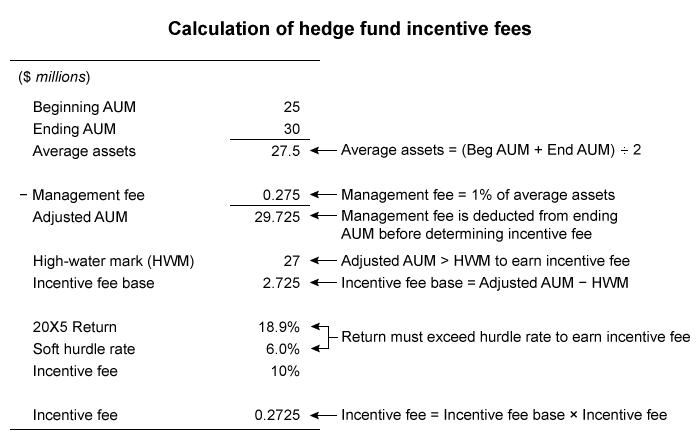
Hedge funds charge a management fee and an incentive fee. The management fee is calculated as a percentage of the total value of the fund's assets under management (AUM). It is assessed each year regardless of profitability.
The incentive fee is levied against the fund's annual gains, subject to certain conditions. It is calculated either gross or net of the management fee. The net calculation subtracts the management fee from AUM to arrive at an adjusted AUM that is used to calculate the fund's profits.
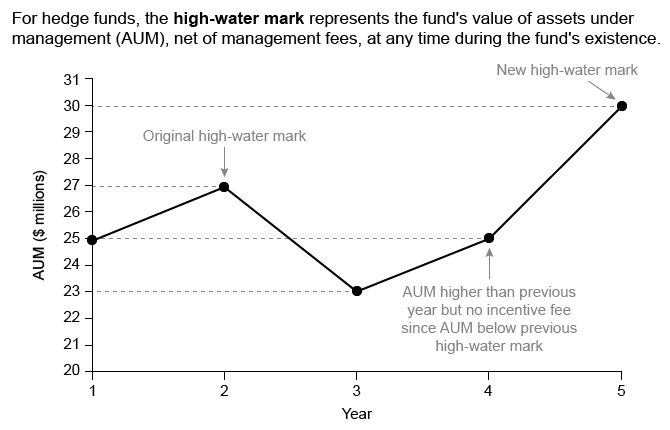
The high-water mark represents the value of AUM, net of fees, at any time during the fund's existence. To earn an incentive fee, the fund must exceed the high-water mark, the base from which the fee is calculated.
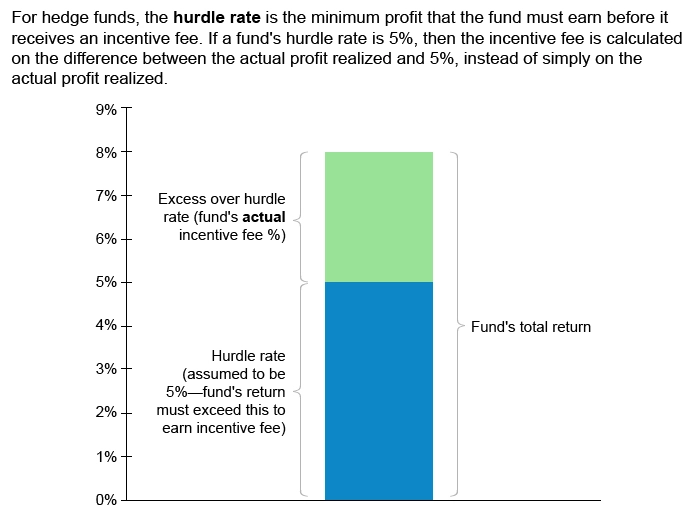
The hurdle rate is the minimum profit that the fund must earn (usually annually) before it receives an incentive fee. The hurdle rate can either be "soft," meaning that the incentive fee is calculated based on the entire profit, or "hard," meaning that the incentive fee is based on only the excess profit above the hurdle rate.
In this scenario, the fund generated net returns in 20X5 of 18.9% ( = (29.725 – 25) / 25 ), above the soft hurdle rate of 6%, and eclipsed the high-water mark of $27 million. Therefore, the fund earned an incentive fee of 10% of profits, net of the management fee on average assets of $27,500,000:
0.10 × (29,725,000 − 27,000,000) = $272,500.
(Choice A) $109,000 is the result of incorrectly assuming a hard hurdle rate is in effect.
(Choice C) $300,000 is the incentive fee if management fees are not deducted.
Things to remember:
Hedge funds charge both a fixed management fee and a variable incentive fee. The incentive fee is contingent on whether the fund earns a profit and may be subject to a high-water mark and hurdle rate.
In the short run, a company maximizing profit in a market with perfect competition produces at a quantity that most likely results in:
- economic profits equal to zero.
- marginal revenue equal to marginal cost.
- market price greater than marginal revenue.
Explanation:
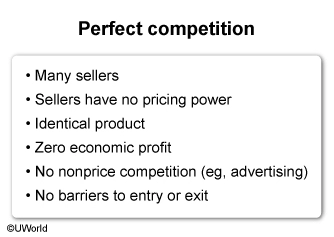
A firm operating under perfect competition maximizes economic profit by producing and selling at the quantity where marginal revenue (MR) equals marginal cost (MC). Cost in this context includes opportunity costs (eg, the owners' required return from the business). Perfectly competitive firms can earn economic profits in the short run, but even if economic profits are zero or negative, a firm may be earning an accounting profit.
MR, the incremental revenue from selling one additional unit, depends on the firm's demand curve. In the case of perfect competition, the demand curve for any individual firm is a horizontal line at the market equilibrium price, since demand is perfectly elastic. Therefore, market price equals MR at all quantities (Choice C).
MC, the incremental cost to produce one additional unit, depends on the firm's cost structure. Producing at a quantity greater than where MR = MC means that the incremental cost for each unit exceeds the incremental revenue generated by that unit and the firm generates a loss on each additional unit sold. Producing at a lower quantity means that the firm forgoes economic profit (in the short run) since the additional revenue from a unit sold would exceed the cost of the unit.
(Choice A) Perfectly competitive firms can earn economic profits in the short run. However, in the long-run, the positive economic profits will attract new firms, which will increase supply/lower price until economic profit is zero.
Note: Although this question specifically addresses perfect competition, the condition that firms optimally produce when MR = MC applies to all market structures. It is likely that the exam will have questions on this topic.
Things to remember:
Under perfect competition, a firm maximizes short-run economic profit by producing and selling at the quantity where marginal revenue (MR) equals marginal cost (MC). Since there is perfectly elastic demand, price also equals MR for all quantities. Short-run, but not long-run, economic profits are possible. However, a firm may earn an accounting profit even if economic profits are zero or negative.
An analyst observes the following market data for one American put option:
| Selected Data | |
| (in CAD) | |
| Stock price | 48 |
| Strike price | 50 |
| Option premium | 4 |
This option's moneyness is best described as:
- in the money.
- at the money.
- out of the money.
Explanation:
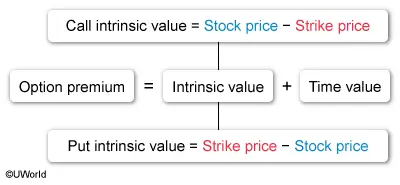
Moneyness refers to the relationship between an option's strike price and the underlying stock price and is indicative of the option's intrinsic value. An option trading at the money or out of the money has no intrinsic value. An option trading in the money has intrinsic value:
- For an in-the-money call option, the underlying stock price is greater than the strike price. This gives the call owner the right to buy the stock at a price lower than the market price, which in turn gives the option intrinsic value.
- For an in-the-money put option, the strike price is greater than the underlying stock price. This gives the put owner the right to sell the stock at a price higher than the market price, which in turn gives the option intrinsic value.
In this scenario, the put option's underlying stock price is less than its strike price. Therefore, the option is trading in the money. Note that the option's premium is irrelevant to determining the option's intrinsic value; it would, however, be relevant to determining the option's profit at exercise.
(Choice B) If the stock price equals the strike price, the option is trading at the money (ATM). At expiration, an ATM option is economically equivalent to owning the underlying asset.
(Choice C) For a call option, if the stock price is less than the strike price, the option is trading out of the money (OTM) and has no intrinsic value. The same is true for a put option if the stock price is greater than the strike price.
Things to remember:
Moneyness refers to the relationship between an option's strike price and the underlying stock price. If the stock price equals the strike price, the option is trading at the money. For a call (put) option, if the stock price is greater (less) than the strike price, the option is trading in the money. For a call (put) option, if the stock price is less (greater) than the strike price, the option is trading out of the money.
The Closest Thing to the Real CFA Exam. Prepare with 5 full-length Level 1 mock exams that replicate the real test experience - featuring a Prometric-style testing interface, accurate topic weighting, and authentic question mix - so nothing feels new on exam day. When exam day arrives, the only surprise will be the testing center.
Buy nowPowerful CFA Study Tools That Reinforce & Retain
Complete your CFA Level 1 prep with a suite of smart, science-backed tools engineered to enhance memory retention, identify and reinforce your weakest topics, track your progress with precision, and ensure your study plan stays strategically aligned and effective from day one through exam day.
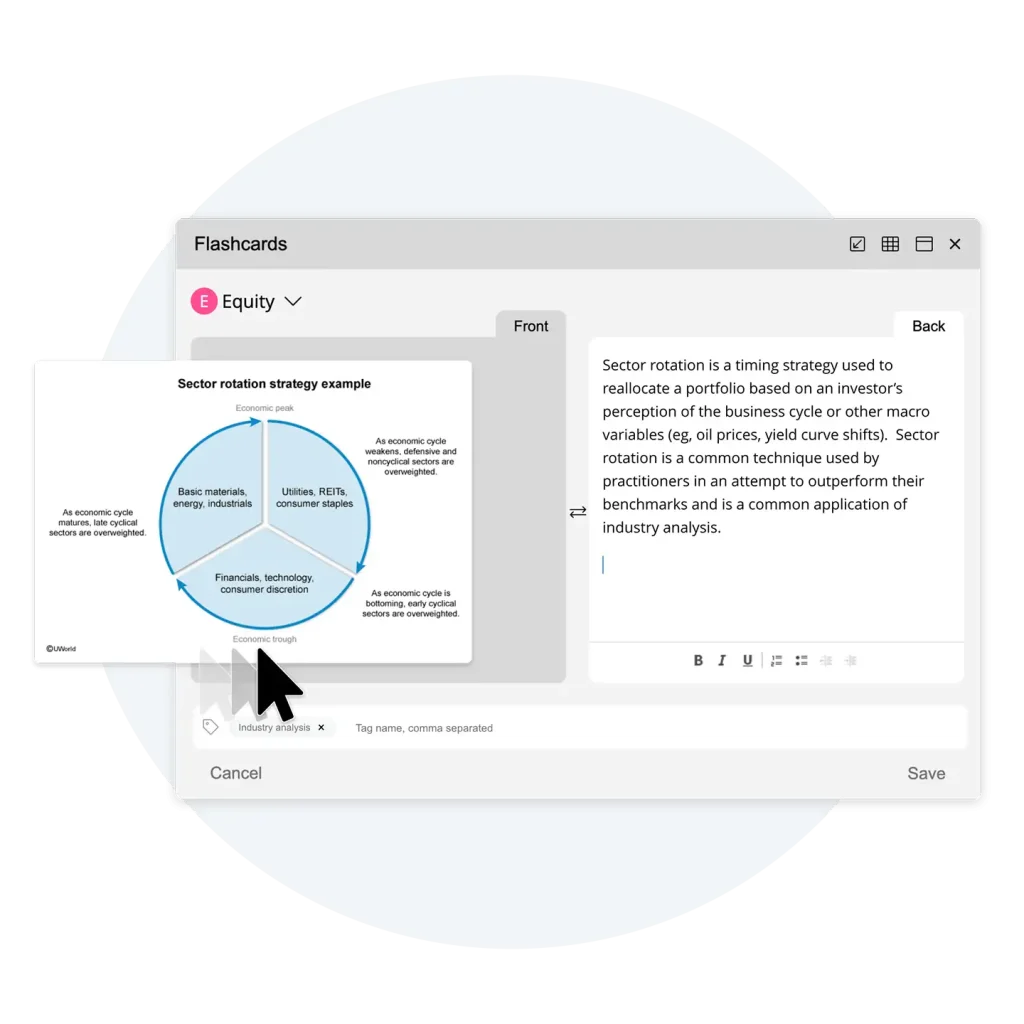
Smart Flashcards
Create unlimited custom CFA flashcards or study with pre-built ReadyDecks. Highlight key concepts, add notes, tag by topic, and let spaced-repetition technology optimize review based on your performance.
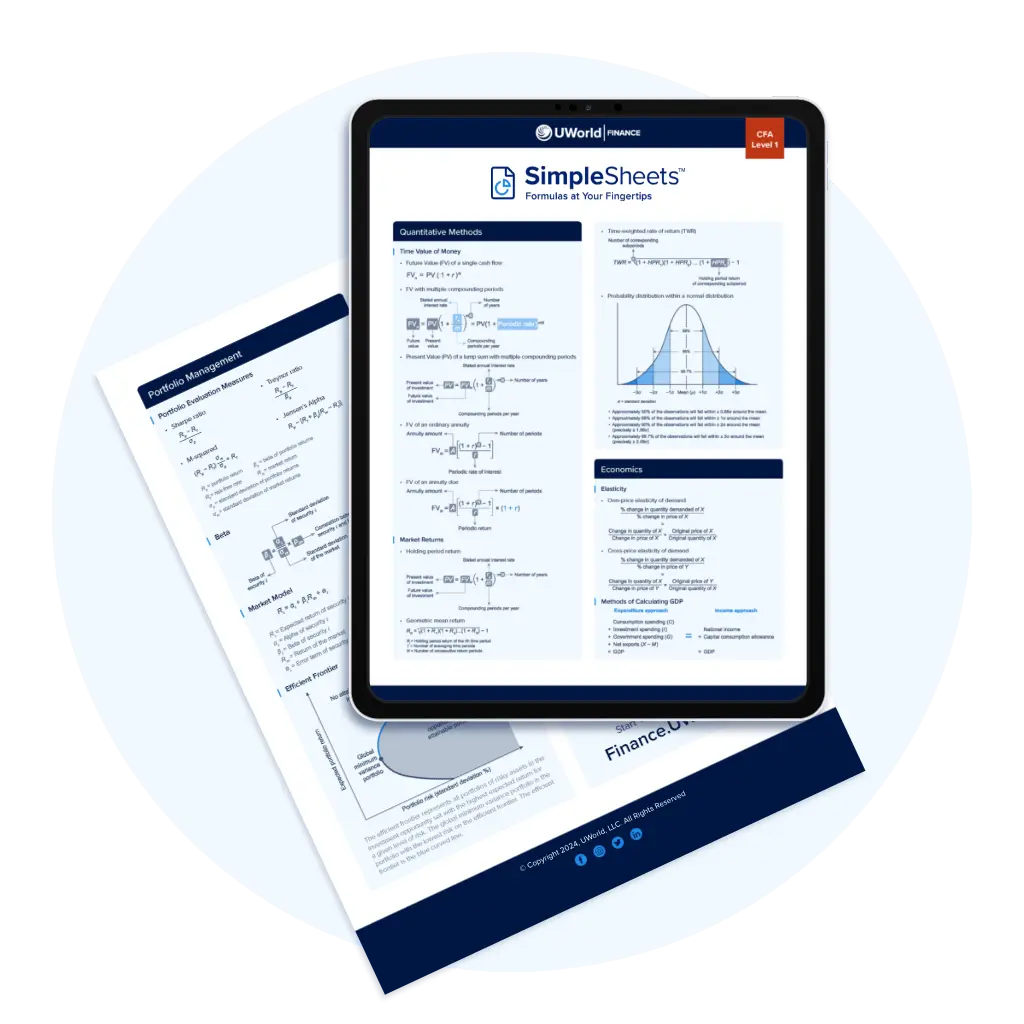
SimpleSheets
Access a streamlined collection of essential CFA Level 1 formulas, definitions, and core concepts. Print them, study online, or download for quick, high-yield review anytime.
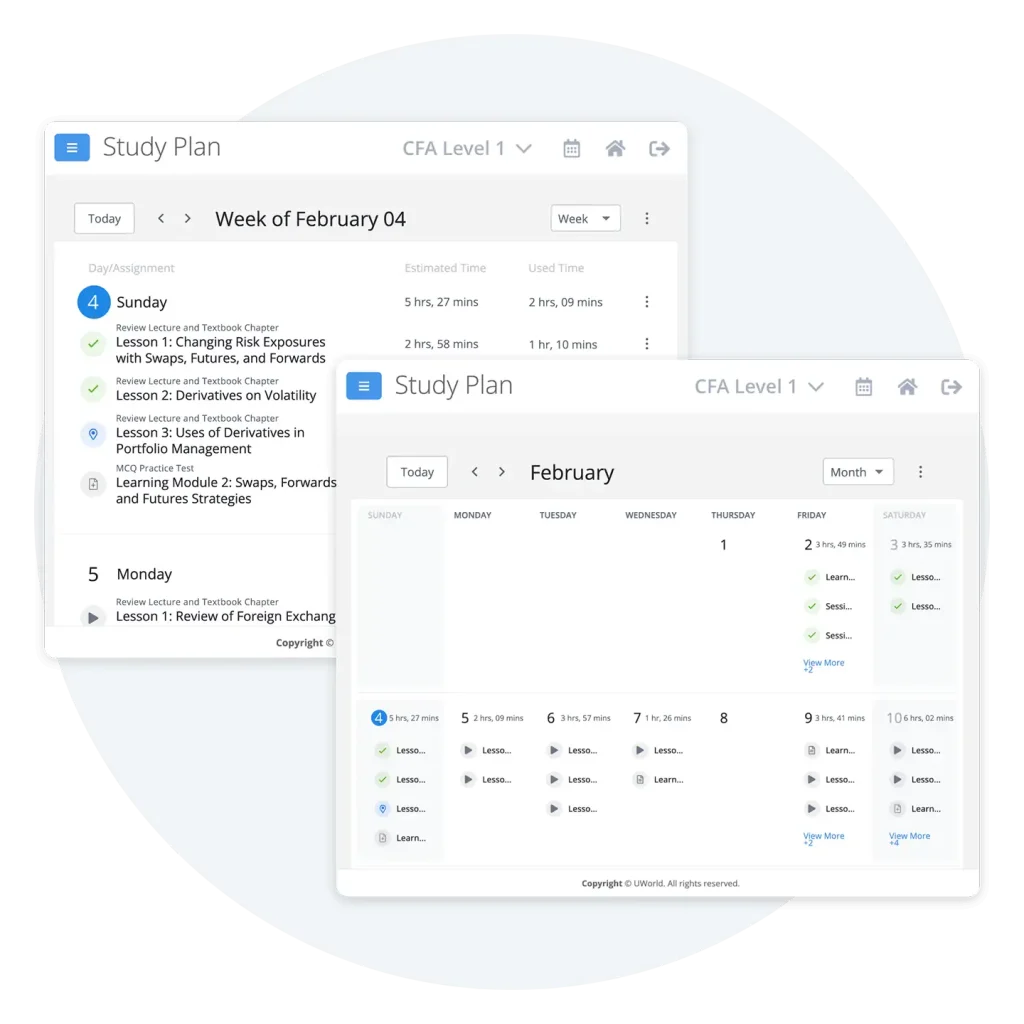
Study Planner
Stay organized with a dynamic CFA study planner that adapts to your exam date, progress, and performance — so you always know what to study next.
StudyPass™
If you don’t pass your CFA Level 1 exam, request an extension and continue studying at no additional cost. Because we’re committed to your success — not just your enrollment.
TotalPrep Series
A complete 3-phase CFA prep system for Levels I–III, combining smart study planning, concept mastery, and expert-led support — including Boot Camps, MasterClasses, and live Q&A — to keep you confident and exam-ready from start to finish.
Smart Flashcards
Create unlimited custom CFA flashcards or study with pre-built ReadyDecks. Highlight key concepts, add notes, tag by topic, and let spaced-repetition technology optimize review based on your performance.
SimpleSheets
Access a streamlined collection of essential CFA Level 1 formulas, definitions, and core concepts. Print them, study online, or download for quick, high-yield review anytime.
Study Planner
Stay organized with a dynamic CFA study planner that adapts to your exam date, progress, and performance — so you always know what to study next.
StudyPass™
If you don’t pass your CFA Level 1 exam, request an extension and continue studying at no additional cost. Because we’re committed to your success — not just your enrollment.
TotalPrep Series
A complete 3-phase CFA prep system for Levels I–III, combining smart study planning, concept mastery, and expert-led support — including Boot Camps, MasterClasses, and live Q&A — to keep you confident and exam-ready from start to finish.
Study Anywhere
Access UWorld’s CFA® study materials on mobile with the same exam-aligned tools you use on desktop—so your preparation stays consistent whether you’re at home, at work, or on the go.

Hear From CFA® Level I Candidates Who Passed
Your CFA Level 1 Prep Journey Starts Here
Unlock success with our expertly crafted CFA Level 1 study course, designed to help you pass with confidence.
Core Essentials
- Study Guides (Digital eBook Access)
- CFA Level 1 QBank
- Performance Tracking Analytics
- Create Custom My Notebook Entries
- Build Custom Flashcard Decks
- Mobile Access via UWorld Finance App
Advanced Prep Course
- Expert-Led Video Lectures
- Mock Exams A & B
- SimpleSheets+ Reference Outline
- Personalized Study Planner
- Expert-curated ReadyDecks Flashcards
Elite Full Course
- Study Guides (Printed Book Set)
- Mock Exams C, D & E*
- StudyPass Access Until You Pass!
- MasterClass On Demand Sessions
- ExpertConnect Live Q&A Sessions
- Accelerate BootCamp Final Review
Study Guides
- 180-Day Digital eBook Access
- Create Custom My Notebook Entries
- Build Custom Flashcard Decks
- Mobile Access via UWorld Finance App
SimpleSheets+
- Digital In-product Supplement
- Access to Fundamental Formulas and Concepts
Mock Exams
- Choose up to 5 Available Exams
- 100+ Questions Not Found in the QBank
- Detailed Performance Tracking Analytics
- Exam-day Ready “Probability of Passing” Score
Learn From the CFA® Instructors Candidates Trust Most
UWorld’s CFA® level 1 exam prep course is led by experienced CFA charterholders and finance professionals with decades of teaching and industry expertise. Instructors are selected for their ability to explain complex concepts clearly, connect theory to real-world application, and prepare candidates for the analytical rigor of the CFA® exam.
Award-Winning Leader in Education Technology
UWorld has been recognized time and again as an innovator in education technology. We follow an iterative process of improvement based on student feedback and performance. UWorld’s accolades include making the GSV 150 list and earning honors like EY Entrepreneur of the Year and multiple EdTech Awards, highlighting our commitment to excellence.
Frequently Asked Questions (FAQs)
What study materials are included in UWorld’s CFA Level 1 course?
UWorld’s online CFA Level 1 course provides a complete study system designed to help you master the curriculum and pass the exam with confidence:
- Video Lessons – Engaging, expert-led instruction covering every topic in the CFA Level 1 curriculum
- Digital and Print Textbooks – Comprehensive study notes aligned with CFA Institute Learning Outcome Statements
- SimpleSheets – Streamlined formula sheets and concept summaries for quick reference and review
- QBank – Thousands of practice questions with detailed explanations to test your understanding
- Smart Flashcards – Pre-made decks or build your own to reinforce key concepts and formulas
- Mock Exams – Full-length practice tests that simulate the actual exam experience
- Personalized Study Planner – Flexible scheduling that adapts to your timeline and commitments
- Performance Analytics – Track your strengths, identify weak areas, and monitor progress throughout your prep
How is UWorld CFA Level 1 different from competitors like Kaplan Schweser or Mark Meldrum?
UWorld takes a fundamentally different approach to CFA level 1 prep – one that prioritizes deep understanding, long-term retention, and adaptive learning over rote memorization.
- Uncompromising Content Quality – UWorld employs dedicated, full-time CFA instructors whose sole focus is creating and refining world-class content. Every question, chapter, and video undergoes multiple rounds of expert review to ensure accuracy, clarity, and ease of understanding. We reinforce learning with professionally designed visuals created by our in-house graphic team, making complex topics more accessible. UWorld doesn’t rush – we invest the time and resources needed to get everything right before it reaches you.
- Learning-First Philosophy – Unlike traditional providers that focus heavily on cramming formulas and shortcuts, UWorld emphasizes true comprehension. Our video lessons and practice questions are designed to help you understand why concepts work, not just what they are – which leads to better retention and exam performance.
- Superior Question Quality & Explanations – Our QBank features thousands of rigorously vetted practice questions with detailed, step-by-step explanations. Every answer – right or wrong – includes a thorough breakdown that reinforces learning. Competitors often provide brief explanations that leave gaps in understanding.
- Integrated Study System – UWorld offers a complete, seamlessly integrated platform: video lessons, digital textbook, QBank, flashcards, mock exams, formula sheets, and a personalized study planner – all in one place. Our technology is intuitive and user-friendly, designed to eliminate distractions so you can focus entirely on learning. You won’t need to juggle multiple resources or subscriptions.
- vs. Kaplan Schweser: While Schweser offers comprehensive materials, UWorld provides deeper explanations, more intuitive technology, better retention-focused tools, and a higher standard of content quality – all at a competitive price point.
- vs. Mark Meldrum: Mark Meldrum offers excellent video content at a lower price, but UWorld delivers a complete ecosystem with superior practice questions, integrated planning tools, mobile accessibility, professional-grade visuals, and ongoing expert support – everything you need in one platform.
How is UWorld CFA prep different from official CFA study materials?
The CFA Institute curriculum is comprehensive and authoritative, but it’s designed as a reference text-not as an optimized study tool. UWorld transforms that curriculum into an efficient, engaging learning system specifically designed to help you pass the exam.
- Designed for Learning, Not Just Reference – The official CFA curriculum is dense, text-heavy, and can be overwhelming. UWorld breaks down complex concepts into digestible lessons with clear explanations, visual aids, and practical examples that make challenging topics easier to understand and retain.
- Expert Video Instruction – While the CFA Institute provides readings, UWorld offers engaging video lessons taught by experienced CFA instructors who explain difficult concepts in plain language, walk through examples step-by-step, and highlight what’s most important for the exam.
- Extensive Practice Questions – The official materials include end-of-chapter questions, but UWorld’s QBank provides thousands of additional practice questions with detailed, educational explanations for every answer choice. This depth of practice is essential for mastering the material and building exam confidence.
- Retention-Focused Tools – UWorld includes smart flashcards, formula sheets (SimpleSheets), spaced repetition features, and performance analytics – tools specifically designed to improve long-term retention. The official curriculum doesn’t offer these active learning resources.
- Personalized Study Planning – The CFA curriculum tells you what to study but not how or when. UWorld’s adaptive study planner creates a customized schedule based on your timeline, tracks your progress, and helps you stay on track from day one to exam day.
- Exam-Focused Approach – UWorld distills the curriculum down to what you actually need to know for the exam, emphasizing high-yield topics and tested concepts. We eliminate the noise and help you focus your time where it matters most.
- Better User Experience – Our platform is intuitive, mobile-optimized, and built for modern learners. You can seamlessly switch between video lessons, practice questions, and study materials all synced across devices for learning anytime, anywhere.
The Bottom Line: The CFA Institute curriculum is the foundation, but UWorld is the complete study system built on top of it. We take the official Learning Outcome Statements and transform them into an engaging, efficient, results-driven prep experience. Think of it this way: the CFA Institute tells you what to learn; UWorld shows you how to master it.
Do I really need to spend money on UWorld CFA Level 1 materials when I have free resources?
You can study using free resources, but here’s what you need to consider: passing the CFA exam isn’t just about accessing information – it’s about how efficiently you can learn, retain, and apply it under exam conditions.
Time is Your Most Valuable Asset – Free resources require piecing together materials from multiple sources – YouTube videos, forums, PDFs, scattered practice questions. With a ~300-hour study requirement, this inefficiency costs you weeks of valuable time.
Quality Varies Widely – Free content isn’t professionally vetted. You might encounter outdated information, inaccurate explanations, or coverage gaps. One wrong concept learned early can compound into multiple missed questions on exam day.
No Structured System – Free resources lack cohesion – no integrated study plan, progress tracking, or adaptive tools to identify weak areas. You’re building your own curriculum from scratch, which is risky for a high-stakes exam.
A complete, proven system with expert-vetted content, thousands of high-quality practice questions with detailed explanations, personalized study planning, performance analytics, professional video instruction, and seamless mobile access – all designed to maximize your efficiency and exam readiness.
The Investment Perspective:
Consider the full picture:
- CFA Level 1 exam fee: Up to ~$1,490
- Your time investment: 300+ hours
- Retake costs if you fail: Another $1,490 and 6 more months
UWorld’s cost is a fraction of the exam fee and a smart investment in passing the first time.
Free resources might save money upfront, but they often cost more in wasted study time, higher failure risk, and delayed career advancement. UWorld isn’t just study materials – it’s an investment in passing the first time and accelerating your career.
How long can I access the CFA Level 1 study materials?
Does the CFA Level 1 test prep include mock exams or full‑length tests?
Are UWorld’s study materials up to date with the 2026 CFA Level 1 curriculum?
What is the recommended study time for CFA Level 1?
What makes UWorld’s video lectures effective for CFA Level 1 prep?
How does StudyPass™ work if I don’t pass on my first attempt?
What financing options are available for the UWorld’s Online CFA Level 1 course?
What discounts or scholarships can help lower the cost of the CFA Level 1 study materials?
- FreshStart™ Discount: If you spent more than $399 on another test‑prep provider and did not pass, UWorld will discount the eligible course price by 50%. This applies to selected products; see eligibility rules on the FreshStart page.
- CFA Institute Scholarships: The CFA Institute offers several scholarships, including the Access Scholarship (reduces the registration fee to about $400), Women’s Scholarship, Student Scholarship, Professor Scholarship and Regulatory Scholarship. Some employers also sponsor candidates.