

- Updated for 2026
CFA® Level 2 Practice Questions
Practice with questions that mirror the real CFA Level 2 exam, expert rationales, powerful visuals, and proven tools unlike any other QBank.
Practice CFA Level 2 Sample Questions
Passage
Compass Engineering's board of directors is deciding between cash dividends or a share repurchase program as a method to begin returning cash to shareholders. Liam Fischer, a member of the board, states that both cash dividends and share repurchases have certain advantages that should be considered:
| Advantage 1: | Share repurchases tend to be more flexible. Although dividends can be raised, lowered, or suspended, they appear to create an expectation among investors that the distribution will continue in the future. Share repurchases do not seem to create the same expectation. |
| Advantage 2: | If the tax rates for capital gains and dividends are the same, and the information content is the same, then shareholders' wealth will be greater with cash dividends since all shareholders receive cash. |
Alicia Wu, the chairman of the board, indicates that Compass should review the long-term trends in the country (the United Kingdom) before deciding.
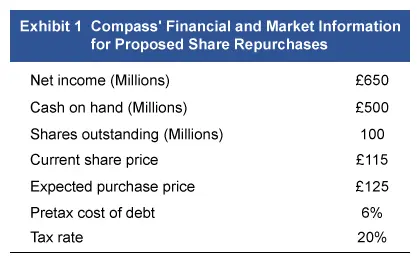
After deliberation, the board favors a share repurchase program. Jessica King, another member of the board, is concerned about the effect of share repurchases on Compass' EPS. She collects the following data for 20X2:
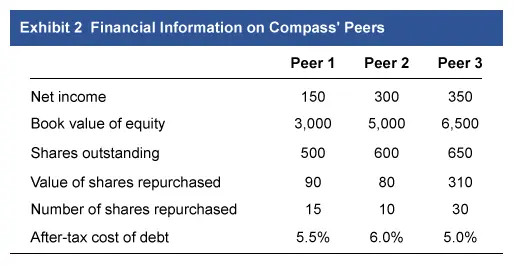
In addition, King wonders what effect share repurchases have on companies' book values. She gathers data from three of Compass' peers who have made a share repurchase:
The board members then discuss the best approach for Compass to repurchase shares. King has identified two possible scenarios, both using the same amount to repurchase shares:
Scenario 1: Purchase shares using all cash on hand.
Scenario 2: Purchase shares with funds from an issuance of debt.
Wu states that her preference is to choose a method by which the company can control the process and execute it quickly. She also prefers a process that would allow Compass to discover the minimum price at which it can repurchase the desired number of shares.
Based on Scenario 1 and Exhibit 1, a share repurchase would cause Compass' 20X2 EPS to be closest to:
Explanation:
Share repurchases are a popular alternative to cash dividends for returning cash to shareholders. Repurchases allow companies to purchase shares currently being held by shareholders using one of several methods. Once repurchased, the shares are either held for reissue (ie, treasury shares) or retired (ie, canceled shares).
The repurchase leaves fewer shares for investors to hold (ie, shares outstanding), which often results in a change to a company's per-share financial ratios (eg, EPS). Like dividends, share repurchases are made using corporate cash, whether the cash is on hand or obtained through the issuance of new debt.
- When cash on hand is used, EPS always increases.
- When new debt is issued, the change in EPS depends on the company's after-tax cost of debt and its earnings yield.
In this question, Compass' EPS following the share repurchase would be £6.77, calculated below.
(Choice A) £6.72 results from incorrectly applying the company's tax rate to the cash used to repurchase shares, arriving at cash of £400 million [£500 million × (1 − 0.2)].
(Choice C) £6.80 incorrectly uses the company's share price instead of the purchase price to calculate the number of shares repurchased. Companies do not always repurchase shares at the market price.
Things to remember:
Share repurchases are a popular alternative to cash dividends. They often result in a change to a company's per-share financial ratios. When cash on hand is used for a repurchase, EPS will always increase. When new debt is issued instead, the change in EPS depends on a company's after-tax cost of debt and its earnings yield.
Passage
Tom Johnson, CFA, is a portfolio manager at Universal Advisors, a US-based wealth management firm that serves high-net-worth individuals and families. Universal's equity portfolio offering includes separately managed accounts (SMAs) in which clients own individual securities. Johnson manages the portfolio with an aggressive high-risk, high-reward strategy, investing mostly in small-cap growth stocks. To reduce transaction costs and to simplify trading and settlement, Universal buys only US-listed securities for client accounts.
Johnson instructs Francois Martin, a CFA Level II candidate and new equity analyst at the firm, to conduct research on Vent Industries, a French wind turbine manufacturer. Vent is dually listed on exchanges in France and in the US. Martin, a French national who recently moved to the US, is already familiar with the company since he has been following it personally for the past two years.
After completing due diligence on Vent, Martin is thoroughly impressed by the investment prospects and suggests that Johnson add the US-listed shares of Vent to client portfolios. Johnson, as the sole decision-maker, reviews Martin's research and financial models but wants to think about the suggestion before reaching a conclusion.
Martin is so impressed with Vent's investment prospects that he wants to buy it for his personal account. For guidance, Martin references Universal's publicly available personal transaction disclosure, which states only the following:
"Investment personnel are subject to policies and procedures regarding their personal trading."
Needing more detail, Martin checks with the firm's compliance officer, who informs him that the firm does have policies and procedures designed to prevent potential conflicts of interest related to personal trading. Universal does not require that employees obtain preclearance before trading, but the firm's policies do require:
- a two-day blackout period before and after client trades, and
- a quarterly report by its investment decision-making personnel on transactions and holdings.
Based on this information, Martin immediately places an order to buy Vent shares listed in France through his personal French brokerage account, which he established prior to joining Universal. Three days later, Johnson decides to invest for clients in the US-listed shares of Vent and places the order through Universal's trading desk.
Johnson is a board member for a local hospital endowment; for this, he receives modest compensation. Universal has approved Johnson's board participation and compensation. Johnson is considered to be a thoughtful and successful investor. The other board members, unhappy with the fees and performance of the endowment's existing income-oriented large-cap equity manager, asked Johnson a year ago if he would be willing to manage the equity portion of the endowment. Johnson responded by stating:
"The hospital provides so much to this community, I would be happy to manage the endowment's equity portfolio. It won't even take much time; I will manage the endowment portfolio as an exact replica of Universal's equity portfolio."
The next month, without informing Universal, Johnson began managing the endowment portfolio as a mirror image of Universal's equity strategy.
Recently, Johnson evaluated the investment prospects of an upcoming IPO for a small-cap biotech firm. The company does innovative cancer research, but it is still years away from profitability. After conducting thorough due diligence, Johnson has concluded this is a great investment opportunity; he would like the hospital endowment to participate, believing the other board members would be excited about the company's cancer research.
Johnson speaks to Universal's lead underwriter and requests that 5% of the firm's IPO allotment be allocated to the endowment. A few days later, when the IPO is priced and allocated, Universal receives 95,000 shares and the endowment receives 5,000 shares.
Which of Universal's procedures for personal investing by employees is inconsistent with CFA Institute's required and recommended procedures?
- There is no preclearance requirement.
- Transaction and holdings disclosures are not frequent enough.
- The blackout period is insufficient to prevent front-running of client trades.
Explanation:
"Investment transactions for clients and employers must have priority over investment transactions in which a Member or Candidate is the beneficial owner."
Standard VI(B) Priority of Transactions stipulates that once a firm has established a policy on personal investing, specific reporting of personal holdings and securities transactions of investment personnel is required to ensure the policy is enforced. Since the policy's overriding goal is to address client concerns regarding personal securities transactions and any conflicts of interest for the firm's employees, enforcement procedures must also be established.
Key elements of the enforcement requirements include:
- Initial disclosure of holdings in which an employee has beneficial ownership (eg, for self, trust, spouse)
- Holdings disclosure, at least annually
- Duplicate transaction confirmations and periodic statements provided to the employer
- Preclearance procedures before the employee can trade
(Choice B) Standard VI(B) stipulates that duplicate transaction confirmations and periodic statements be provided, but it does not specify how frequently. Transaction confirmations should be done at the time of trade to ensure adequate supervision of activity, but quarterly holdings disclosure is adequate and common in most circumstances.
(Choice C) A blackout period is a recommended (not required) policy, and each firm has discretion regarding the period's duration. Although the minimum period is not specified, a blackout of two days before and after a client trade is likely adequate to minimize market impact and prevent a conflict of interest and/or front-running of client trades.
Things to remember:
The key requirements of Standard VI(B) for investment personnel include trade preclearance and reporting personal holdings and securities transactions.
Passage
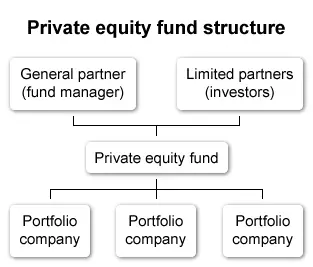
Chao Li is a vice president at Tailwind Capital, a private equity (PE) firm. He is currently raising £100 million for Tailwind Fund A. Li meets with An Heng, an associate at Insular Insurance Co., a potential institutional investor. In their meeting, Li explains the general structure of PE funds to Heng:
Statement 1: The limited partners (LPs) and the general partner (GP) in a private equity fund participate in managing the fund.
Statement 2: The GP is entitled to carried interest, which is typically a percentage of the fund's profits after management fees.
Statement 3: PE funds are closed-end funds, so LPs can redeem their investments only at specified times.
Heng says, "I understand there are costs associated with investing in PE, such as significant performance fees, dilution costs whenever the PE firm starts new funds, and annual audit costs. And I know that there are some agency risks involved with investing in a PE fund. Is there a governance provision that would address GP gross negligence?"
Subsequently, Li raises the full £100 million for Fund A. One of the fund's investments is ModernWare, an online services company. The initial investment is £20 million: £13 million in debt, £2 million in preferred equity, and £5 million in the PE fund's equity. Tailwind plans to sell ModernWare 5 years from now and plans to reduce the debt balance by £10 million by the time of exit. The promised return for the preferred equity holders is 15%.
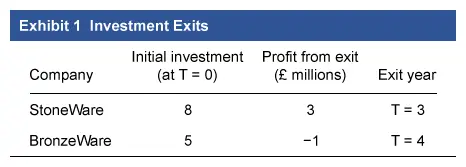
Several years after the fund's inception, Tailwind exits two investments: StoneWare and BronzeWare (Exhibit 1). Carried interest to the GP is accrued on a deal-by-deal basis and equals 20% of the profits from each exit. The hurdle rate is 10%. When a deal's IRR is above the hurdle rate, carried interest is accrued; when a deal's IRR is below the hurdle rate, a clawback penalty amount is accrued if there is a loss.
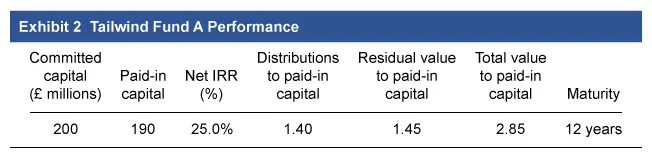
Twelve years after the fund's inception, Li meets with Heng again to review Fund A's performance, shown in Exhibit 2.
Which of Li’s statements on Tailwind's fund structure is incorrect?
- Statement 1
- Statement 2
- Statement 3
Explanation:
Statement 1: The limited partners (LPs) and the general partner (GP) in a private equity fund participate in managing the fund.
Statement 2: The GP is entitled to carried interest, which is typically a percentage of the fund's profits after management fees.
Statement 3: PE funds are closed-end funds, so LPs can redeem their investments only at specified times.
PE funds are typically structured as limited partnerships in which the GP (ie, fund manager) acts as an agent on behalf of the LPs (ie, investors). The GP actively manages the fund and is responsible for all debts (ie, unlimited liability). The LPs commit capital to the GP, and their liabilities are limited to their invested amounts. Statement 1 is incorrect since LPs are not actively involved in managing the fund.
(Choice B) In exchange for managing funds, GPs charge management fees, some transaction fees, and carried interest.
(Choice C) PE funds are closed-end funds since existing investors are restricted from redeeming their shares for long periods of time. In addition, new investors can be restricted from entering the fund during certain windows.
Things to remember: A private equity fund consists of a general partner (GP) (ie, fund manager) and limited partners (ie, investors). The GP is entitled to management fees and carried interest in exchange for managing the fund. However, the GP is responsible for all the fund's debt (ie, unlimited liability), whereas the limited partners' liabilities are limited to their invested amounts.
Passage
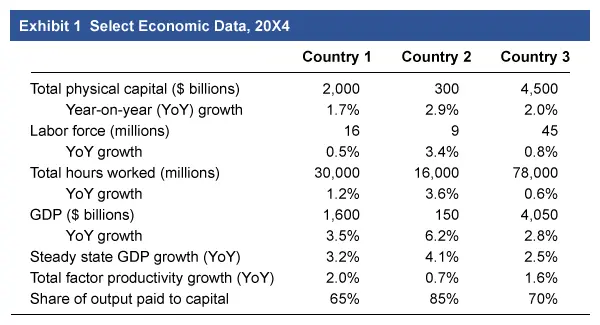
Botan Saito is a portfolio manager for Spire Financial. Spire's investments are largely domestic, and Saito plans to diversify Spire's holdings by adding investments in international markets. Saito identifies three countries that he will research further. He collects the following economic data for each country, using average year-on-year growth rates:
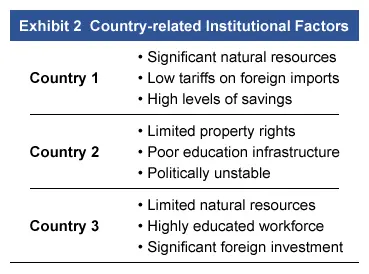
During his research, Saito realizes that numbers are not fully explaining the economic differences in these countries. He further researches institutional economic information, shown in Exhibit 2:
Country 2 is planning to implement new policies that create a more open trade policy. Saito expects that this will result in a higher permanent steady-state GDP growth rate.
Saito is interested in how economic factors will ultimately impact each country's stock market. He notes that Country 3's:
- GDP growth is slightly above the country's steady-state GDP growth rate in 20X4;
- earnings-to-GDP ratio was above the country's historical average in 20X4; and
- price-to-earnings ratio of the country's publicly traded stocks was below its historical average in 20X4.
Saito is also interested in how potential GDP will affect each country's bonds. He arrives at the following conclusions:
Conclusion 1 Actual GDP growth relative to a country's potential GDP growth rate is an important factor in central bank decision-making and the likelihood of changes to the central bank's policies.
Conclusion 2 A decrease in a country's potential GDP growth rate increases the likelihood that the credit ratings on its sovereign debt will be downgraded.
Saito wishes to identify how capital deepening will affect each country's per capita output growth. Based on the neoclassical model, which of the following factors is most appropriate for Saito to consider?
- Capital-to-labor ratio
- Steady-state GDP growth
- Average hours worked per worker
Explanation:
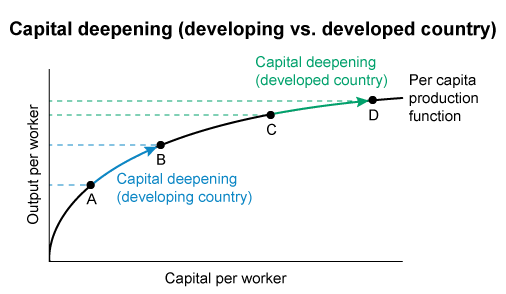
Capital deepening is an increase in a country's capital per worker (ie, capital-to-labor ratio). When workers gain more capital, they traditionally become more productive. However, the neoclassical model of economic growth states that the per capita production function, which measures capital per worker against output per worker, exhibits diminishing marginal returns. Therefore, when a country has a greater capital-to-labor ratio, it will likely see a smaller per capita output increase from capital deepening than if it had a lesser capital-to-labor ratio, all else equal.
(Choice B) Steady-state GDP growth considers several factors, including capital growth, labor growth, capital and labor as a percentage of total factor cost, and total factor productivity. Therefore, this measure would not be the most appropriate to identify how capital deepening will affect each country's growth in output per capita.
(Choice C) Average hours worked per worker affects the factor of labor, not capital, when calculating economic output. Therefore, this measure would not be the most appropriate to use when specifically identifying how capital deepening will affect each country's growth in output per capita.
Things to remember:
Capital deepening is an increase in a country's capital per worker. In the neoclassical model, the per capita production function has diminishing returns. Therefore, a country with a greater capital-to-labor ratio will likely see a smaller output increase from capital deepening than a country with a lesser capital-to-labor ratio.
Passage
Herman Schmidt is a fund manager working at Rosige Zukunft LLC (RZ), a derivatives trading firm. RZ uses the carry arbitrage model to assess the value of bond forward contracts. Exhibit 1 contains information on several German government bonds that pay coupons once per annum and have five years remaining until maturity. Schmidt directs Hedwig Meyer, an RZ analyst, to price forward contracts on Bond A, Bond B, and Bond C. The 6-month risk-free rate is 1.50% and the 1-year risk-free rate is 2.00%.
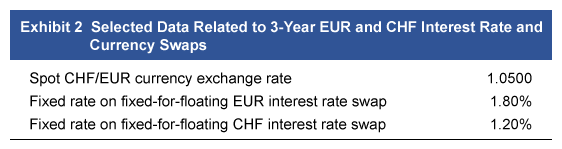
Schmidt and Meyer discuss different methods for valuing interest rate and currency swaps. Exhibit 2 contains information on at-market EUR and CHF interest rate swaps, and the CHF/EUR exchange rate.
Schmidt has RZ initiate a fixed-for-fixed EUR/CHF currency swap, agreeing to pay 1.20% in CHF and receive 1.80% in EUR. RZ exchanges the swap notional with the counterparty at contract initiation, paying EUR 10 million and receiving CHF 10.5 million. Six months later, at-market 2.5-year fixed-for-fixed EUR/CHF currency swaps are quoted at 1.60% EUR for 1.40% CHF and the spot CHF/EUR exchange rate is 1.1000.
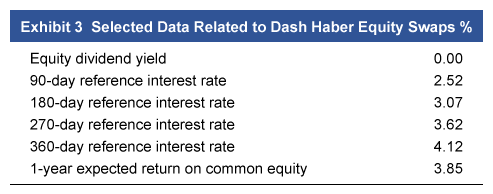
Schmidt anticipates that the equity of Dash Haber Ltd., a UK clothing retailer, will outperform versus expectations. He decides to use a 1-year, quarterly settled, equity-return-for-fixed-interest rate swap to gain long exposure to Dash Haber equity. Exhibit 3 contains information related to the swap:
All interest rates are annual compound rates and are based on a 360-day year.
Based on Exhibit 1, the no-arbitrage 6-month forward price of Bond A is most likely:
- less than its spot price.
- equal to its spot price.
- greater than its spot price.
Explanation:
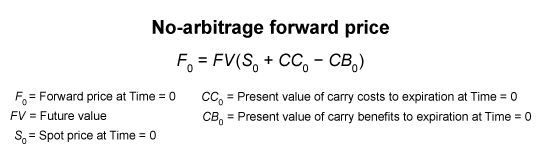
The no-arbitrage forward price of an asset is the:
- future value of the asset's spot price, adjusted for the
- costs and benefits (ie, "carry" costs and benefits) of holding the asset to the forward contract expiration.
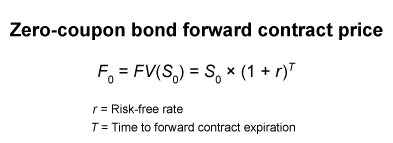
The forward price of a zero-coupon bond is just the future value of the bond's spot price since there are:
- no explicit carry costs, due to the opportunity cost of capital being captured in the future value of the spot price, and
- no carry benefits since a bondholder receives no periodic coupon payments.
As a result, CC0 and CB0 in the formula above both equal 0, reducing the calculation of the no-arbitrage forward price to:
In this scenario, the 6-month forward price of the 5-year zero-coupon bond (ie, Bond A) is calculated as:
F0 = 86.261 (1.015)0.5 = 86.906
If interest rates are positive, the no-arbitrage forward price of an asset with no holding costs or benefits is greater than the asset's spot price (Choices A and B). The spot/forward price difference reflects the opportunity cost of capital (eg, cost of financing a position in the asset) over the time to the forward contract expiration.
Things to remember:
The no-arbitrage forward price of an asset is the future value of the asset's spot price adjusted for the costs and benefits of holding the asset to the forward expiration. The forward price of an asset with no holding costs or benefits is above the asset's spot price by the opportunity cost of capital over the time to the forward expiration.
Passage
AussieParent Ltd, headquartered in Australia, is a multinational holding company that frequently engages in foreign currency transactions. AussieParent prepares its consolidated financial statements in accordance with IFRS. Its main subsidiary in Australia is Aussieteks, a distribution and logistics company.
On Dec 1 20X5, Aussieteks:
- purchased NZD 5,000,000 of supplies on credit from a New Zealand supplier, with payment due in 30 days in NZD, and
- sold and provided NZD 7,500,000 of services to a New Zealand customer on credit, with payment due in 60 days in NZD.
Aussieteks settles its payable on Dec 30 20X5 and collects its receivable on Jan 30 20X6. The company's fiscal year ends on December 31. The relevant exchange rates are shown in Exhibit 1 (NZD is the base currency):
AussieParent's Turkish subsidiary, Turkteks, began operations in 20X6 and primarily operates in Turkish lira (TRY). On May 30 20X6, Turkteks purchased inventory for TRY 50 million. Due to customer contract disputes, none of the inventory was sold in 20X6. By Dec 31 20X6, the general price index had increased by 65% since purchase, indicating hyperinflation. Economists expect the trend to continue for the next three years. The exchange rates for 20X6 were:
Separately, AussieParent consolidates the financial results of Nipponteks, its Japanese subsidiary, at the end of 20X6. Nipponteks primarily operates in AUD and has the following account balances on Dec 31 20X6 (all figures are in JPY):
- Cash: 5,000,000
- Receivables: 3,000,000
- Payables: 5,850,000
- Deferred income taxes: 1,150,000
Based on the rates in Exhibit 1, Aussieteks' foreign currency transaction gain (loss) on Jan 30 20X6 (in AUD) from collecting its accounts receivable is closest to:
- −7,500
- 22,500
- 30,000
Explanation:
Companies that purchase or sell goods or services in a foreign currency are exposed to transaction-based foreign exchange risk when settlement occurs after the initial transaction. When the settlement date occurs in a subsequent financial reporting period from the initial transaction date, companies must:
-
on the balance sheet date (eg, the end of the reporting period), remeasure the payable or receivable based on the FX rate on that date and recognize an unrealized transaction gain (loss) on the income statement, and
-
on the settlement date (which will occur in a subsequent recording period), recognize a transaction gain or loss based on changes in the FX rate from the last balance sheet date.
In this scenario, the initial sales transaction date is Dec 1 20X5, the balance sheet date is Dec 31 20X5, and the settlement date for collecting cash is Jan 30 20X6.
Aussieteks reported an AUD 30,000 FX gain on the balance sheet reporting date due to NZD appreciation. Then, Aussieteks experienced an AUD 7,500 translation loss due to NZD depreciation between Jan 1 20X6 and Jan 30 20X6.
(Choice B) AUD 22,500 is the entire net gain over both reporting periods. However, the value must be recorded, so a transaction gain (loss) must be recognized in both the period ending on the balance sheet date and the period ending on the settlement date.
(Choice C) AUD 30,000 is the unrealized transaction gain as of the balance sheet date of Dec 31 20X5.
Things to remember:
For foreign currency transactions settled in a later period, companies first remeasure the payable or receivable at the exchange rate as of the balance sheet date, recording an unrealized transaction gain or loss on the income statement. When the transaction is later settled, companies record a realized transaction gain or loss based on exchange rate changes since the last remeasurement.
Passage
Henri Pellatoir is an analyst for Q-Vex, Inc., a large Canadian manufacturer. Using quarterly financial data compiled over the last 15 years, Pellatoir wishes to project the company's gross profits. Exhibit 1 presents the historical data to be used in the analysis:
Pellatoir is using an AR(1) model for his analysis. Exhibit 2 shows the results of the regression model:
Pellatoir reviews the results of the analysis and determines that the model is misspecified. He makes a modification to the initial model, with results shown in Exhibit 3:
Pellatoir quickly establishes that the updated model does not have unit roots. Additional testing confirms that the updated model is properly specified and can be used to model the company's gross profit in future periods. After making the modifications to the model, Pellatoir is concerned about the presence of heteroskedasticity. He discusses this with another analyst, Zoe Arsenault, and she responds by stating that:
| Statement 1: | The presence of heteroskedasticity most likely will result in failure to reject a false null hypothesis. |
| Statement 2: | Autoregressive conditional heteroskedasticity (ARCH) regression models can estimate future error variances only if the null hypothesis of the ARCH test is rejected. |
Based on Exhibits 1 and 2, Pellatoir's most appropriate conclusion is that the model is misspecified since the:
- residuals are serially correlated.
- time series exhibits exponential growth.
- Durbin-Watson statistic differs significantly from 2.0.
Explanation:
Serial correlation occurs when the error terms of a regression are correlated, which is a violation of regression assumptions. When serial correlation is present, the t-statistics used for hypothesis tests on the regression coefficients will incorrectly appear to be significant. Models exhibiting serial correlation are misspecified and will require adjustments before any hypothesis testing can be performed.
For AR models, serial correlation is detected by performing a t-test on the autocorrelation of the residuals, in which the null hypothesis (H0) is that the autocorrelation t-statistic equals zero, indicating that serial correlation is not present.
Exhibit 2 lists the autocorrelation t-statistics. Each of these is compared against the model's critical t-value (given here as 2.00). On the fourth lag, the t-statistic is greater than the critical value (3.6023 > 2.00). H0 is rejected, and therefore the appropriate conclusion is that the residuals are serially correlated.
A common example of serial correlation is exponential growth: Values continuously grow at a particular rate, which implies the model has persistent rather than uncorrelated error terms. Exponential growth is present if the time series values in a graph increase or decrease at progressively higher rates. Exhibit 1 shows that profits were relatively unchanged or slightly lower over time, so the time series does not exhibit consistent exponential growth across the 15-year period (Choice B).
(Choice C) The Durbin-Watson (DW) hypothesis test checks for serial correlation by comparing the DW statistic with DW critical values. However, the DW test cannot be applied to AR models.
Things to remember:
A regression on a time series must be tested for different types of violations, such as serial correlation, before any meaningful hypothesis testing can be performed.
Passage
Yannes Bolger is a newly hired junior analyst at a derivatives trading firm, working on an interest rate option trading desk managed by Hidemi Okura. To assess Bolger's understanding of derivatives, Okura first asks him which combination of interest rate puts and calls is most similar to a pay-fixed, receive-floating forward rate agreement (FRA).
She then asks Bolger to identify which of the strategies below is equivalent to being short an interest rate cap and long an interest rate floor, assuming both options are 1-year contracts based on the 3-month market reference rate (MRR), with quarterly settlement payments, 3% exercise rates, and $1 million notional amounts.
| Strategy 1: | Positions in two $1 million par value 1-year bonds that pay interest quarterly: long a floating-rate bond with a coupon rate based on the 3-month MRR, and short a 3% fixed-coupon bond. |
| Strategy 2: | A 1-year, $1 million notional, quarterly settled, receive-fixed, pay-floating interest rate swap with a 3% fixed-rate leg and a floating-rate leg based on the 3-month MRR. |
| Strategy 3: | Long a payer swaption on a 1-year, quarterly settled, $1 million notional swap with a 3% fixed-rate leg and a floating-rate leg based on the 3-month MRR. |
A corporate client contacts Okura for advice on structuring a debt offering. The client wants to borrow at a fixed cost for a specified maturity but expects interest rates to rise over the next few years. The client believes the bond market is underpricing interest rate options relative to the derivatives market. Therefore, the client asks how interest rate options might be used to achieve the preferred fixed-rate funding for the specified maturity while also reducing financing costs by taking advantage of the mispricing of embedded calls in the bond market.
Another client has requested a quote on a €10 million notional amount, 2-year, 4% European interest rate put. Okura asks Bolger to value the put option using the binomial interest rate tree shown in Exhibit 1.
Which of the following positions is most appropriately identified as being equivalent to a pay-fixed, receive-floating FRA?
- Short an interest rate call and long an interest rate put
- Long an interest rate call and short an interest rate put
- Long an interest rate cap and short an interest rate floor
Explanation:
A FRA is a forward contract on an interest rate, established between two counterparties: a buyer (long) who pays the fixed rate and receives the floating rate, and a seller (short) who pays the floating rate and receives the fixed rate. For FRAs held until expiration, there is a single cash settlement payment based on the difference between the FRA fixed rate and the MRR at expiration. At expiration:
- if MRR > FRA rate, the seller pays the buyer.
- if MRR < FRA rate, the buyer pays the seller.
FRAs are equivalent to simultaneous long and short interest rate calls and puts with exercise rates equal to the FRA fixed rate:
- Fixed-rate payer (ie, long) = long call and short put
- Fixed-rate receiver (ie, short) = short call and long put (Choice A)
The FRA fixed-rate payer receives a settlement payment if MRR > FRA rate; the greater the difference, the larger the payment. Conversely, if MRR < FRA rate, the fixed-rate payer makes a payment, which increases as the MRR declines more. This is the same payment pattern for an investor who is long calls and short puts on the MRR if both option exercise rates equal the FRA fixed rate:
-
If MRR > Exercise rate, the call is in the money and the investor receives a payment based on the rate difference.
-
If MRR < Exercise rate, the put is in the money and the investor makes a payment based on the rate difference.
(Choice C) An interest rate cap (floor) is a single derivative contract containing a portfolio of options known as caplets (floorlets) having a series of possible settlement payments. Therefore, being long an interest rate cap and short an interest rate floor is not equivalent to a FRA, which has a single settlement payment.
Things to remember:
FRAs are equivalent to simultaneous long and short interest rate puts and calls with exercise rates equal to the FRA fixed rate.
Passage
Karsten Knapp and Inna Schilling are financial advisors at Bloxx Investments, a wealth management firm. They are assessing the suitability of ETFs for existing clients who currently invest in mutual funds. Knapp is concerned that ETFs trading at a premium or discount to their NAV may affect clients' returns. He asks Schilling's opinion, and she makes the following statements:
| Statement 1: | Fixed income ETFs typically have lower premiums and discounts than equity ETFs. |
| Statement 2: | An index with an active futures market contributes to increased premiums and discounts of ETFs benchmarked to that index. |
| Statement 3: | The percentage of foreign securities held and the frequency of trading are factors that influence ETF premiums and discounts. |
Knapp and Schilling discuss the total costs of owning an ETF. Schilling explains that trading costs can be a significant portion of total costs, depending on the holding period. She gives Knapp an example based on PJW, an ETF that tracks the S&P 500 Index:
- Management fee: 0.30% per year
- Commission: 0.08% per trade
- Bid-offer spread of 0.14% on purchase and sale
- Holding period: 15 months
Schilling then says that ETFs have specific types of risk, and Knapp asks for more details. Schilling gives examples of events related to ETF risks, including "soft" closures.
Lastly, Knapp and Schilling discuss ETF applications and how ETFs can be used to increase the overall efficiency of a portfolio. Schilling tells Knapp that ETFs are often employed, for example, when an active manager moves the portfolio out of a certain asset class or factor that Bloxx's clients want to remain exposed to. This temporary gap can be offset by purchasing liquid ETFs and maintaining exposure to that asset class or factor.
Which of Schilling's statements about ETF premiums and discounts is correct?
- Statement 1
- Statement 2
- Statement 3
Explanation:
| Statement 1: | Fixed income ETFs typically have lower premiums and discounts than equity ETFs. |
| Statement 2: | An index with an active futures market contributes to increased premiums and discounts of ETFs benchmarked to that index. |
| Statement 3: | The percentage of foreign securities held and the frequency of trading are factors that influence ETF premiums and discounts. |
ETF premiums and discounts are implicit costs of trading ETFs and are calculated according to end-of-day or intraday NAV. If the ETF price is greater (less) than the NAV of the ETF's basket of securities, the ETF is trading at a premium (discount).
Factors that influence ETF premiums and discounts include:
-
Foreign securities held. The trading hours of foreign exchanges are typically different from the trading hours of the exchange where the ETFs are traded. This leads to situations where the NAV is a poor indicator of an ETF's fair value (eg, the ETF's exchange is open but the NAV is based on "old" prices for securities traded in a now-closed foreign exchange).
-
Frequency of trading. Differences in prices may occur if the securities held by the ETF are frequently traded but the ETF is not.
Therefore, ETFs holding foreign securities or trading infrequently typically have greater premiums or discounts relative to NAV.
(Choice A) Fixed income securities are traded over the counter, without continuous pricing. Fixed income ETFs are based on pricing indications from bond desks or pricing services, resulting in higher premiums/discounts than equity ETFs, which hold stocks continuously traded in exchanges.
(Choice B) Futures contracts allow investors to promptly hedge their positions on the underlying security, keeping the security's price closer to its fair value. Therefore, ETFs benchmarked to an index with an active futures market will be traded closer to their NAV, decreasing premiums and discounts.
Things to remember:
If an ETF's price is greater (less) than the NAV of its basket of securities, the ETF is trading at a premium (discount). ETFs holding foreign securities or trading infrequently typically have greater premiums or discounts relative to NAV.
Passage
Ellis Howard is a junior equity analyst for a university endowment fund. The fund's policy for evaluating equity investments is to use free cash flow to the firm (FCFF) and free cash flow to equity (FCFE) to estimate a company's intrinsic value. Howard's supervisor asks about her methods for forecasting FCFF and FCFE from a company's reported net income. Howard replies:
| Method 1: | When determining changes in working capital, I do not include short-term notes payable as part of current liabilities. |
| Method 2: | When using net income to derive FCFF or FCFE, I do not normally add back deferred tax liabilities to net income. |
Howard is asked to evaluate Horizon ElectroCar as a potential investment. The company's selected financial information is shown in Exhibit 1:
The notes to the company's financial statements disclose the following information:
- The tax rate is 40%.
- In 20X1, Horizon spent SGD 1.0 million to repurchase common equity shares and borrowed SGD 1.3 million.
- There are no notes payable, and all debt is long term.
- The company classifies interest paid as cash from operations (CFO).
Howard estimated Horizon ElectroCar's per-share FCFE for 20X0 to be SGD 2.50. The applicable risk-free interest rate is 2%. Exhibit 2 shows Howard's estimates for the ranges of inputs used to value Horizon ElectroCar with a constant-growth FCFE model:
Howard is also evaluating Innovation Resources, which is located in Chad, where there has been high inflation in recent years. Relevant information concerning Chad and Innovation Resources is shown in Exhibit 3:
Finally, although Howard understands the endowment fund's rationale for valuing equity investments based on the company's free cash flow (FCF), she believes that other metrics can be adequate substitutes for FCF. She makes the following statements to support her position:
| Statement 1: | If a company makes no investment in fixed capital, then EBITDA can be used as a proxy for FCFF. |
| Statement 2: | CFO is the same as FCFE if the company's investment in PPE is equal to its net amount of borrowing. |
Which of Howard's methods concerning FCF forecasting is (are) appropriate?
- Only Method 1
- Both Method 1 and Method 2
- Neither Method 1 nor Method 2
Explanation:
| Method 1: | When determining changes in working capital, I do not include short-term notes payable as part of current liabilities. |
| Method 2: | When using net income to derive FCFF or FCFE, I do not normally add back deferred tax liabilities to net income. |
Estimating current and future FCFF and FCFE, starting from a company's net income, requires adjustments for investments in working capital and noncash charges.
Working capital includes a company's short-term assets and liabilities. However, FCFF is estimated from a company's operating cash flows, which excludes cash from financing activities. Notes payable are short-term liabilities that typically bear interest and are classified as cash from financing. Howard is correct to exclude them when calculating changes to working capital, so Method 1 is appropriate (Choice C).
Deferred tax liabilities and assets are examples of noncash items; they represent the difference between accounting tax expense and taxes actually paid and/or owed. Most deferred tax items result from timing differences, such as using straight-line depreciation for financial reporting and accelerated depreciation to determine actual taxes paid each year. Generally, the differences reverse over time; in those cases, an analyst should not adjust net income by the amount of the deferred asset or liability. Howard's Method 2 is also correct (Choice A).
Things to remember:
FCF estimates based on net income require adjustments for working capital investment and noncash charges. Notes payable are short-term liabilities, but if they are interest-bearing, they are excluded from working capital since they represent cash from financing, not from operations. Deferred tax assets and liabilities are noncash items, but analysts should use them to adjust net income only if they are not expected to reverse over time.
Ready to practice all 1,350+ CFA Level 2 questions?
Accelerate Your CFA Level 2 Prep with Smarter Learning
Exam-Style Item Sets
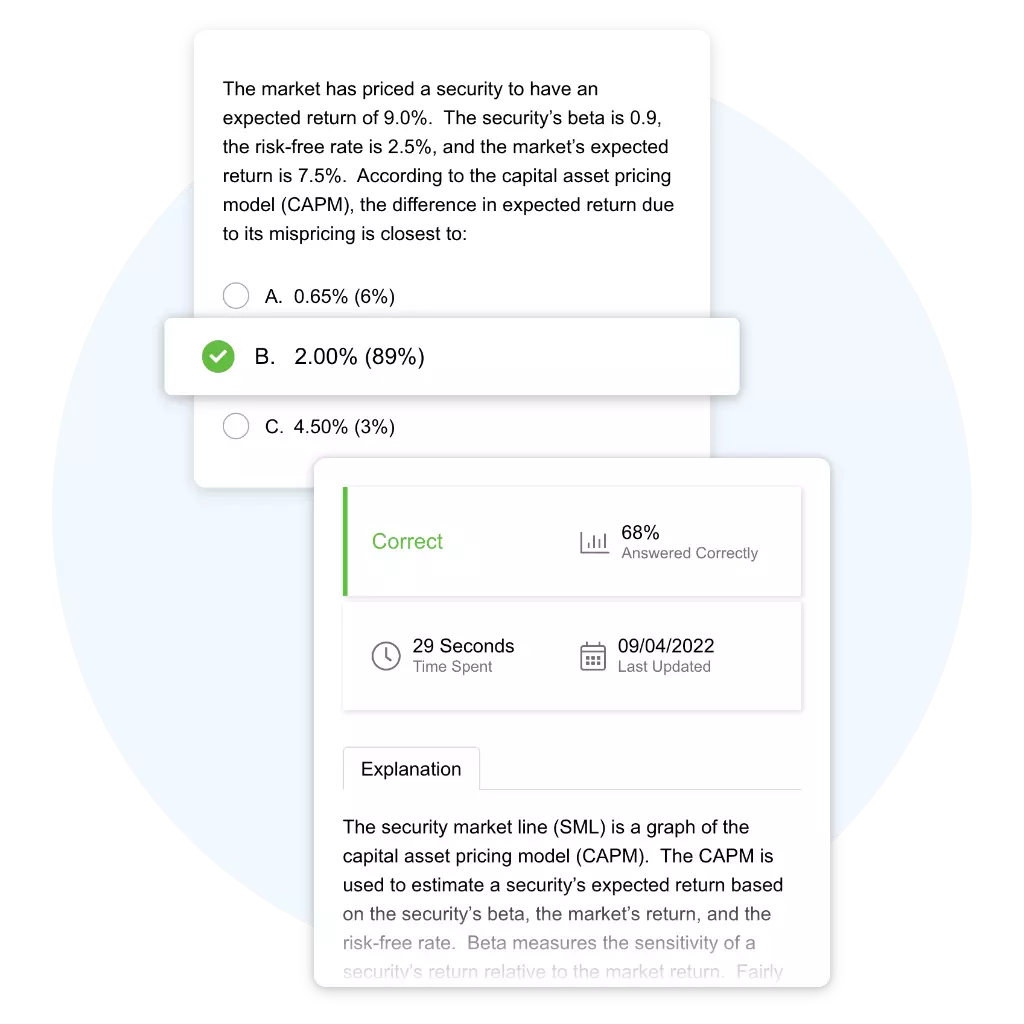
Practice with vignette-based question sets that mirror the CFA Level 2 exam experience, combining real-world scenarios, integrated data, and multi-part analysis.
- Improve exam-day confidence
- Strengthen scenario interpretation
- Make accurate decisions under pressure


Learn with Visual Explanations
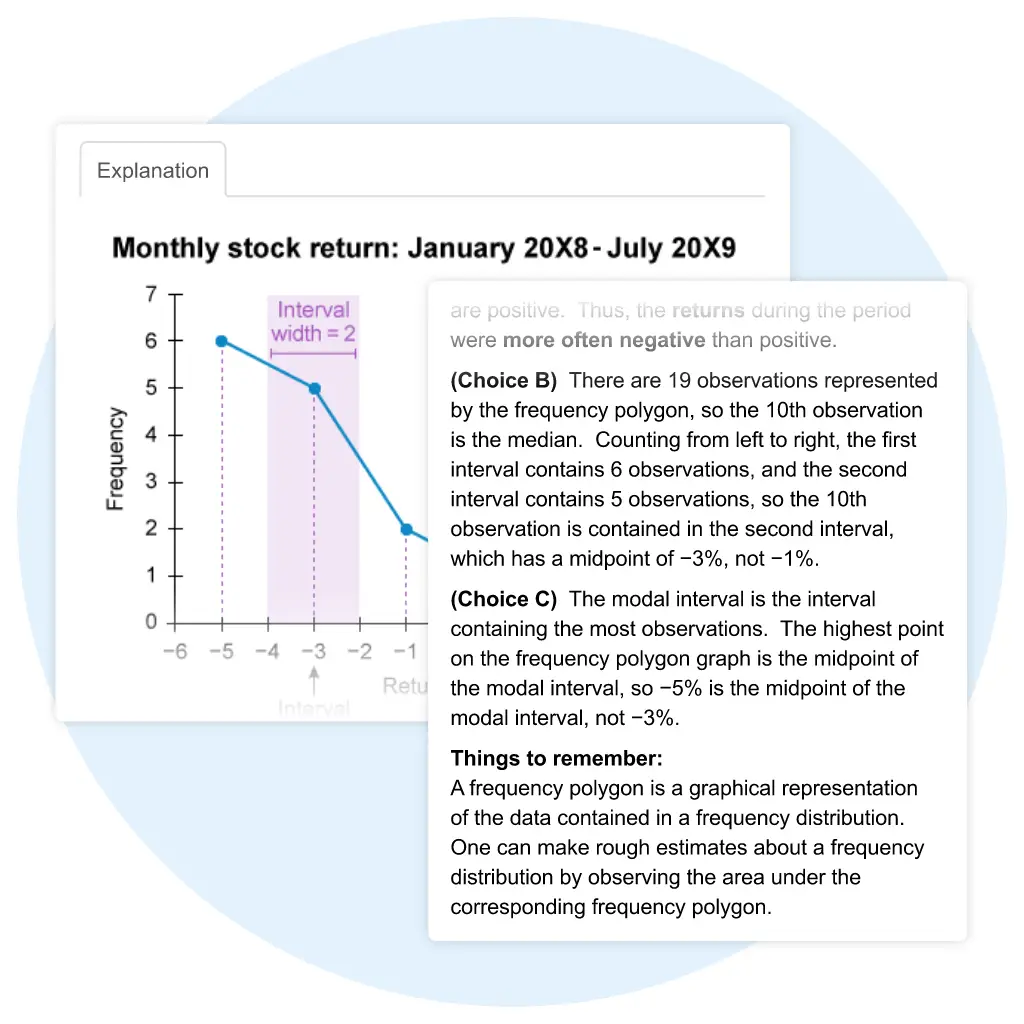
Every answer comes with original tables, flowcharts, and illustrations created by our charterholder team to build deep conceptual understanding not surface memorization.
- Learn the reasoning behind every answer
- Absorb complex concepts faster
- Reinforce learning with visual explanations
Up-to-date LOS-Mapped
Every question is mapped directly to the current CFA Level 2 curriculum and Learning Outcome Statements, so your study time stays focused on what truly matters.
- Study with precision and confidence
- Prioritize high-impact topics
- Avoid wasting time on low-yield content
Smart Tools That Accelerate Retention
Personalized CFA Study Planner
Build a customized day-by-day study plan tailored to your exam date, available study hours, and performance trends automatically adapting as you improve.
- Personalized around your exam timeline
- Adapts dynamically to your progress
- Structured coverage across all 10 topics
- Built-in buffer time for revision and review
Ask Your CFA AI Assistant
Get instant, curriculum-aligned explanations for CFA Level 2 concepts, formulas, and difficult questions whenever you need extra clarity.
- Available anytime, day or night
- Responses aligned to the CFA curriculum
- Clear explanations for concepts and formulas
- Ask about any topic or Learning Outcome Statement
Data-Driven Exam Preparation
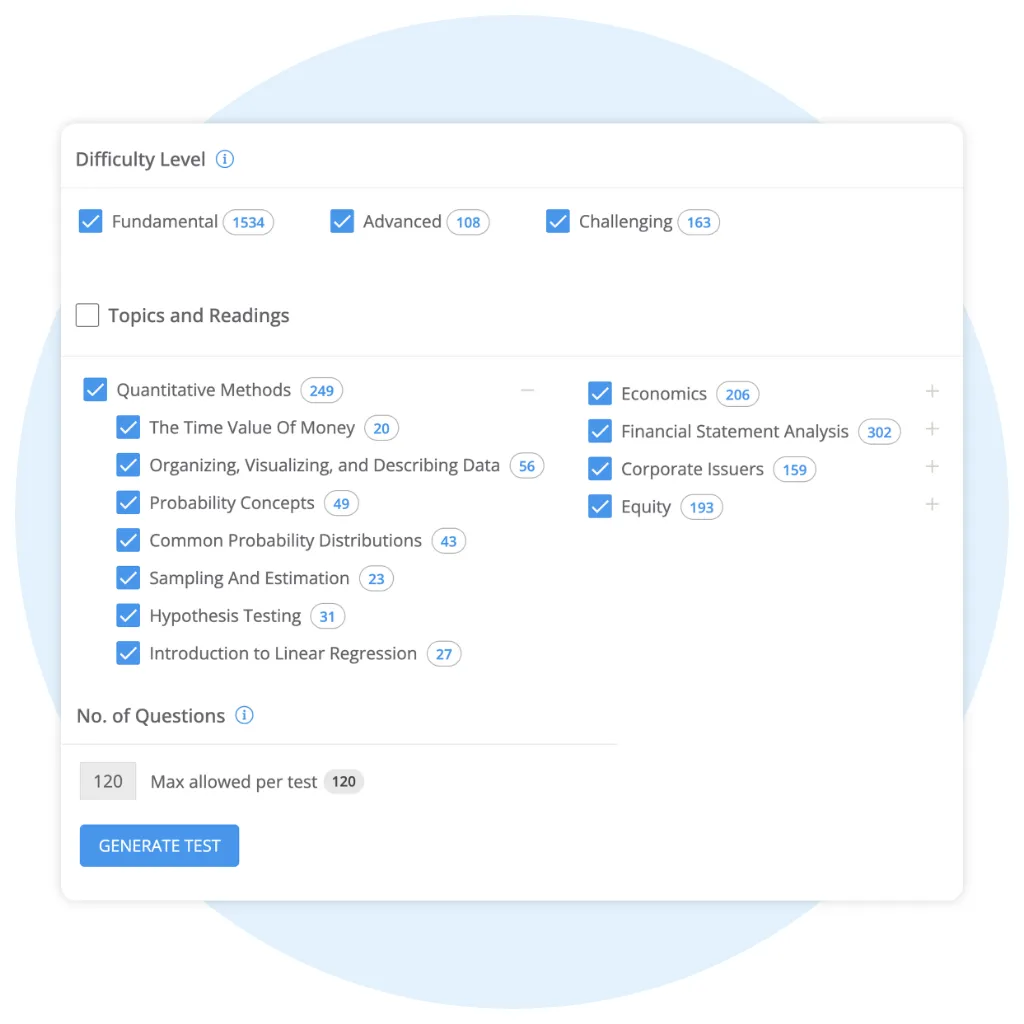
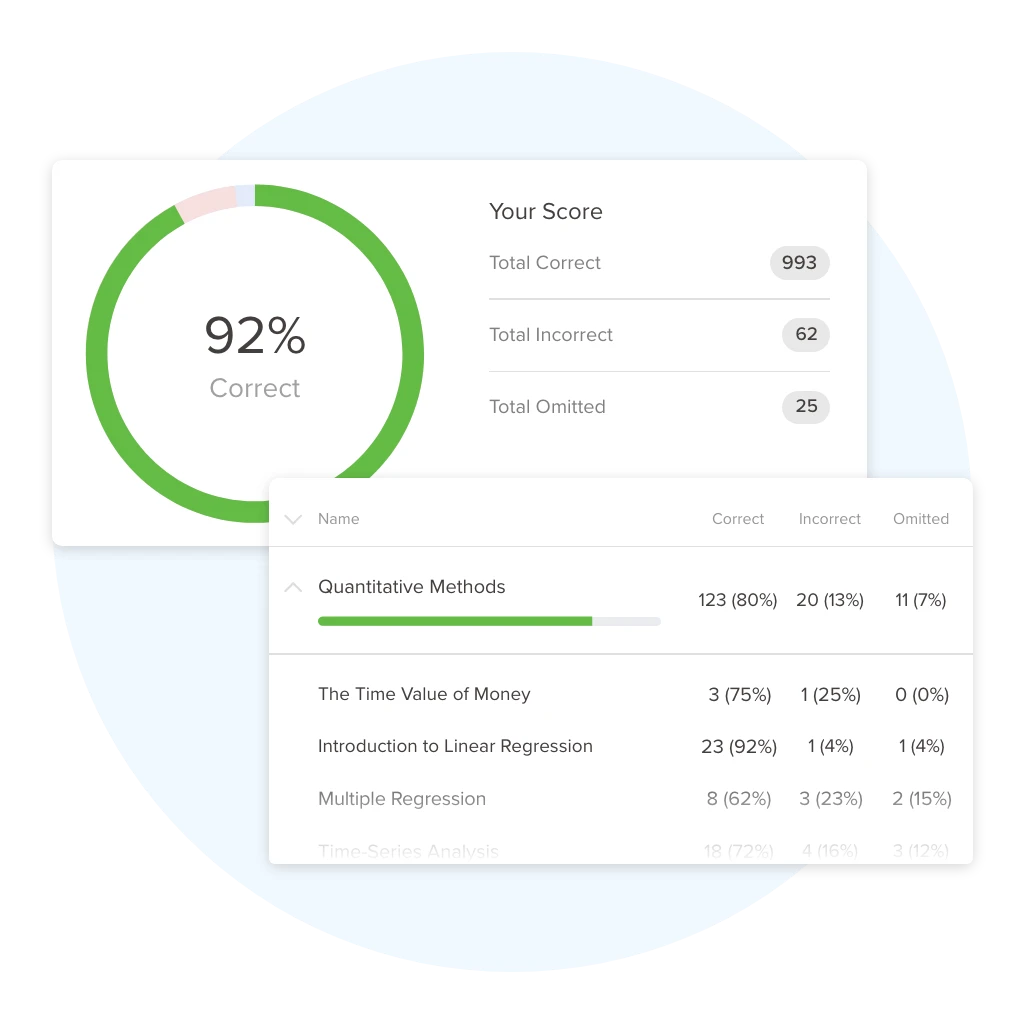
Track your progress across topics, question types, and difficulty levels with real-time performance insights designed to sharpen your exam readiness.
- Performance tracking by topic & LOS
- Identify strengths and weak areas instantly
- Monitor accuracy and improvement over time
- Actionable insights for smarter revision
Never Pause Your CFA Preparation
Access your full CFA Level 2 prep experience on any device, with seamless syncing across mobile and desktop so you can study wherever life takes you.
- Full access across desktop and mobile
- Syncs automatically across devices
- Study during commutes, breaks, or travel
- Offline access for uninterrupted learning
The Smartest Way to Master CFA Level 2
Candidates Who Passed With UWorld
Application-based questions are very nuanced and further help strengthen the underlying concept. My favorite, the QBank itself, can help one learn the whole curriculum thoroughly just through practice questions.
Choose Your CFA Level 2 Practice Package
QBank
- Full CFA Level 2 QBank
- Performance Tracking Analytics
- Organize Custom Notes with My Notebook
- Review with Custom Flashcard Decks
- Mobile Access via UWorld Finance App
Mock Exams
- Choose up to 3 Available Exams
- 100+ Questions Not Found in the QBank
- Exam-day "Probability of Passing" Score
Prep Courses
- Study Guides (eBook or Printed Set)
- Expert-led Video Lessons
- Mock Exams
- UAskTM AI Powered CFA Tutor
- Personalized Study Planner
- Expert-curated ReadyDecks™ Flashcards
- StudyPass™ Access Until You Pass!
- MasterClass™ On Demand Sessions
- ExpertConnect™ Live Q&A Sessions
- Accelerate BootCamp™ Final Review
What Sets UWorld Apart from Other CFA Level 2 Providers
Not all CFA Level 2 question banks are built the same. Here is exactly how UWorld compares.
| Feature | UWorld | Other Providers |
|---|---|---|
|
Question Authorship
|
✅ Charterholder-Written
Authored by active CFA charterholders for real-exam precision |
❌ Generalist Authors
Often written by generalist teams, leading to imprecise exam framing |
|
Answer Explanations
|
✅ Full Concept Explanations
Step-by-step logic for every answer choice to build deep understanding |
❌ Not Detailed
Correct answer only, leaving gaps in understanding |
|
Visual Illustrations
|
✅ Original Visual Per Question
Purpose-built charts and diagrams to simplify complex concepts |
❌ Majority Text-Only
Mostly text-based, no original visual aids |
|
Question Difficulty
|
✅ Exam-Appropriate
Calibrated to match the actual CFA Level 2 exam |
❌ Varies
not specifically calibrated to CFA Level 2 difficulty |
|
Curriculum Alignment
|
✅ Aligned to Latest LOS
The question is mapped to current 2026 CFA Institute requirements |
❌ Outdated or Unverified
May include outdated or irrelevant content |
|
Performance Analytics
|
✅ Advanced Analytics
Real-time tracking by topic and LOS to pinpoint exact weak areas |
❌ Basic Only
Limited insight into your performance gaps |
Authored by active CFA charterholders for real-exam precision.
Often written by generalist teams, leading to imprecise exam framing.
Step-by-step logic for every answer choice to build deep understanding.
Correct answer only, leaving gaps in understanding.
Purpose-built charts and diagrams to simplify complex concepts.
Mostly text-based, no original visual aids.
Calibrated to match the actual CFA Level 1 exam.
Not specifically calibrated to CFA Level 1 difficulty.
The question is mapped to current 2026 CFA Institute requirements.
May include outdated or irrelevant content.
Real-time tracking by topic and LOS to pinpoint exact weak areas.
Limited insight into your performance gaps.
CFA Level 2 Practice Questions: FAQs
Why are UWorld CFA Level 2 practice questions different from others?
UWorld CFA takes a fundamentally different approach to CFA Level 2 exam preparation that prioritizes deep understanding, long-term retention, and targeted practice over rote memorization. Here is exactly what sets our CFA Level 2 practice questions apart.
Uncompromising question quality: UWorld CFA employs dedicated, full-time CFA charterholders whose sole focus is creating world-class practice questions. Every question in the CFA Level 2 question bank undergoes multiple rounds of in-house expert review to ensure accuracy, clarity, and alignment with the current CFA Institute curriculum. Nothing is outsourced or generated by non-practitioners. We also reinforce every explanation with original visual illustrations created by our in-house graphic team, making complex topics like currency exchange rate models, residual income valuation, fixed income arbitrage-free frameworks, and derivatives pricing far more accessible than text-based explanations alone.
Learning-first philosophy: Unlike traditional providers that focus heavily on drilling financial formulas and memorizing answer patterns, UWorld emphasises true comprehension. Every CFA Level 2 practice question is designed to help you understand why an answer is correct, not just what it is. Our explanations cover every answer choice, correct and incorrect, with step-by-step reasoning that builds genuine conceptual mastery. This approach leads to better retention and stronger exam performance because you can reason through vignettes you have never seen before, not just recognize scenarios you have memorized.
Superior explanations for every answer choice: Most CFA Level 2 question banks provide a brief explanation for the correct answer and nothing more. UWorld provides a thorough breakdown for every answer choice. When you understand why option A fails and why option C is a common trap, you develop the analytical thinking skills that transfer to any item set the real exam throws at you. That depth of explanation is the single biggest difference candidates notice when they switch to UWorld from another provider.
Real-time performance analytics by topic and LOS: Knowing your overall score is not enough information to improve. UWorld tracks your accuracy at the topic level and the Learning Outcome Statement level in real time. You can see not just that you are weak in Fixed Income but exactly which LOS within Fixed Income is costing you marks. Combined with a personalized study planner that auto-adjusts to your performance data, UWorld gives you a targeted preparation system rather than a library of CFA Level 2 sample questions to work through randomly.
A fully integrated study system: UWorld offers a complete, seamlessly integrated platform that goes beyond CFA Level 2 example questions alone. Video lectures, digital study notes, QBank, flashcards, My Notebook, and a personalized study planner are all in one place. Our technology is intuitive and designed to eliminate distractions so you can focus entirely on learning without juggling multiple resources or subscriptions.
How we compare to other providers
Vs. Kaplan Schweser: Schweser offers comprehensive materials, but UWorld provides deeper explanations for every answer choice, more intuitive technology, stronger retention-focused tools, original visual illustrations per question, and a higher standard of content quality, all at a competitive price.
Vs. AnalystPrep: AnalystPrep provides accessible practice at a lower price point, but UWorld delivers superior explanation depth, original visuals, advanced performance analytics, integrated video lectures, and ongoing curriculum updates validated by CFA Institute annually.
Who writes the UWorld CFA Level 2 QBank questions and explanations?
Every question and explanation in the UWorld CFA Level 2 QBank is written by an in-house team of active CFA charterholders and subject matter experts. Each question goes through a rigorous multi-stage review process to ensure accuracy, clarity, and alignment with the current CFA Institute curriculum. Nothing is outsourced or generated by non-practitioners.
Our charterholders bring real-world investment experience to every CFA Level 2 practice question they write. That means the vignette scenarios, calculations, and answer choices reflect how concepts actually appear on the real exam, not how a generalist content writer might interpret a textbook. Every explanation is written to teach the concept, not just reveal the answer.
How similar are the UWorld CFA Level 2 practice questions to the actual exam?
Every question is written as part of a multi-question item set built around a detailed case vignette, with three answer options, A, B, and C, and a single best answer. This is the exact format used on the CFA Level 2 exam. Our interface also replicates the Prometric testing environment so you are already familiar with the look, feel, and navigation before you sit down on exam day. There are no surprises.
How many practice questions do I get with the Level 2 free trial?
The UWorld free trial gives you access to a representative sample of CFA Level 2 practice questions across multiple topic areas, complete with full answer explanations, step-by-step problem-solving guides, and professionally designed visual illustrations. No credit card is required to get started.
The free trial is designed to give you a genuine feel for the depth and quality of the full QBank before you commit to a paid plan. You will be able to experience the vignette format, the visual learning aids, and the performance analytics firsthand. Most candidates who try the free trial find they have enough information to decide whether UWorld is the right fit for their preparation.
Does the UWorld CFA Level 2 QBank cover all topics on the CFA Level 2 exam?
Absolutely. One of the biggest concerns for CFA Level 2 candidates is whether their prep material truly covers the full curriculum, and our QBank is built to do exactly that.
Our CFA Level 2 QBank is fully aligned with the latest CFA Institute curriculum and includes comprehensive coverage of all 10 topic areas and every Learning Outcome Statement (LOS). From Ethics and Financial Statement Analysis to Equity, Fixed Income, Derivatives, and Portfolio Management, you can practice the full range of concepts tested on exam day.
The questions are designed in the same vignette based format used on the actual Level 2 exam, helping you build both conceptual understanding and exam level problem solving skills. Detailed explanations, visual learning tools, and performance analytics also help you identify weak areas and focus your revision more effectively throughout your preparation.
Does UWorld provide past CFA Level 2 exam questions for practice?
No. As an officially approved prep provider by CFA Institute, we do not use or distribute past CFA exam questions. Instead, our in-house charterholders create original CFA Level 2 example questions that authentically replicate the real exam in style, difficulty, format, and rigor.
This approach ensures your practice is both ethically sound and highly effective. Past exam questions are also not a reliable study tool because the CFA curriculum is updated annually. Questions from previous years may reference deprecated material or concepts that are no longer tested. Our questions are written and reviewed against the current curriculum every year so you are always practicing what will actually appear on your exam.
Are CFA Exam questions easier than UWorld's CFA Level 2 practice questions?
Our charterholders design every CFA Level 2 practice question to be at exam-appropriate difficulty, calibrated to match the actual exam in style and rigor. The goal is to build real readiness and confidence, not to make practice harder than it needs to be.
Candidates who complete the full QBank consistently report feeling familiar and confident when they sit the real exam. They have already worked through the vignette structures, handled common traps embedded in item sets, and built the stamina needed for a full Level 2 sitting. That preparation is what makes the difference on exam day.
How does UWorld help candidates succeed on the CFA Level 2 Exam?
UWorld CFA is built around a three-stage learning system that addresses the most common reasons candidates fail.
First, performance analytics help you identify exactly where your knowledge gaps are across all 10 topic areas and every Learning Outcome Statement. Instead of studying everything equally, you focus your time where it actually moves the needle.
Second, every set of CFA Level 2 sample questions comes with detailed explanations for correct and incorrect answer choices, helping you build genuine conceptual mastery. You understand the reasoning behind every answer, which means you can handle vignettes you have never seen before, not just scenarios you have memorised.
Third, unlimited custom question sessions simulate real exam conditions so you build stamina, timing, and confidence before exam day. This structured approach is why UWorld candidates consistently report feeling well prepared when they sit the CFA Level 2 exam.
How long does it take to complete the UWorld CFA Level 2 QBank?
Most candidates complete the full CFA Level 2 question bank over a 3 to 5 month study period, spending around 1 to 2 hours per day. The right pace depends on your exam date, prior knowledge, and available study time.
We recommend using the UWorld Study Planner to build a personalized day-by-day schedule aligned to your exam date. The planner takes into account your available hours and auto-adjusts as your performance data changes. Many candidates go through the QBank more than once, using performance analytics to focus repeat sessions on their weakest areas rather than repeating questions they already answered correctly.
Can I use the UWorld CFA Level 2 QBank as my only study resource?
Many candidates use the UWorld CFA Level 2 practice questions as their primary study resource and pass the exam. The QBank includes detailed explanations for every answer choice, visual illustrations that teach concepts, video lectures mapped to every LOS, study notes, flashcards, and a personalized study planner. Together these tools cover both learning and practice.
That said, the right approach depends on your background and how far in advance you begin studying. Candidates with a strong finance background who are comfortable with the increased complexity of Level 2 often find the QBank alone is sufficient. Candidates newer to the vignette format or the depth of topics like FRA, derivatives, or fixed income may benefit from pairing it with study books or a structured course. UWorld offers both through the TotalPrep series if you want a more comprehensive package.